
Can AI Help Us Find Hidden Connections Across Mathematics?

“A mathematician is a person who can find analogies between theorems; a better mathematician is one who can see analogies between proofs and the best mathematician can notice analogies between theories. One can imagine that the ultimate mathematician is one who can see analogies between analogies.”
—Stefan Banach
One of the most beautiful aspects of mathematics is the rich web of interactions and interconnections between different subfields. Through these we can think about a single problem in many different ways, with each perspective offering its own advantages. A basic example is the elementary connection between geometry and algebra that arises when we assign coordinates to points in space. Through this, the geometric problem of finding where two lines intersect can be transformed into a problem of solving for x and y in a pair of equations. The familiarity of this construction makes it hard to appreciate its deep significance, shaping the way we have thought about space ever since.
These kinds of connections are a central theme in today’s mathematics research. A modern example is the Langlands program which revolves around the discovery of hidden connections between representation theory (the mathematical study of symmetry) and number theory. Indeed, there are many active fields of mathematics whose very name shows that they are about fusing the ideas of two different subfields: algebraic combinatorics, algebraic topology, geometric group theory, geometric representation theory, etc.
What makes discovering connections between different areas of mathematics hard? Insight and intuition play a fundamental role (probably the limiting role in the final analysis), but breadth of knowledge is also a bottleneck. The mathematics literature is vast and the barrier to entry is very high between subfields. I can go to NeurIPS, sit in almost any session and have at least a high-level sense of what is being discussed. If I try to attend a Joint Math Meetings talk outside my area of expertise, I am lucky if I understand the first five minutes.
From this perspective, AI systems are well-positioned to accelerate mathematics. Even if it ultimately proves hard to consistently elicit creativity from these systems, their breadth of knowledge should enhance our ability to draw on multiple areas of mathematics simultaneously. There was some disappointment in the AI community when OpenAI initially announced the solution of several Erdos problems and then quickly clarified that what had been discovered was unrecorded solutions in the existing literature1. On the other hand, many mathematicians I know saw this as the demonstration of an incredibly powerful and useful capability.
Perhaps because of the level of abstraction involved in mathematics, theorems that are equivalent can look completely unrelated when they are framed in the jargon of another field, leading to the same result being re-discovered multiple times. This motivated a team of undergraduates and I at the Math + AI Lab at University of Washington to explore whether current top text embedding models can go beyond surface-level, lexical similarity to capture rich, representations of mathematical text (Jiaying Ye, Samarth Rao, Leo Carlin, Kedar Chintalapati, Saharsh Bhargava, Rachit Jaiswal, Michael Zhou, Jared Darlington, Jiahe Lu, Jarod Alper, Vasily Ilin, Henry Kvinge, Does My Embedding Reflect That A=B? Evaluating Mathematical Equivalence in Embedding Models). We specifically asked whether these models tend to embed mathematically equivalent statements near one another. If they did, this would allow us to identify connections between different fields through the simple process of embedding a corpus of mathematical results and looking for cases where instances drawn from one field appear particularly close to instances from another.
Several people have asked why we even care about small text embedding models when we know that powerful LLMs like GPT-5.5 can make non-trivial connections between distant mathematical fields (e.g., the unit distance problem solution provided by OpenAI)? The reason is simple, very few mathematicians will be able to run state-of-the-art LLMs across large bodies of mathematical text (e.g., all math papers on the arXiv). Enabling large-scale comparisons like this opens possibilities that may be unattainable with only targeted search.
To understand a text embedding model’s ability to cluster text by mathematical equivalence we designed a dataset called Mathematically Equivalent but Lexically Different Pairs (MELD) which consists of pairs of mathematically equivalent statements framed in the language of different subfields. Examples include statements in the language of vector spaces vs. module theory, the language of Fourier analysis vs. representation theory, the language of algebraic topology vs. group theory, or the language of set theory vs. category theory.
Notably, all pairs are drawn from a basic graduate-level math curriculum. Since most text embedding models will have seen this material, we don’t need to worry about issues where embedding structure is impacted by training data coverage.
Unsurprisingly, most text embedding models generally perform quite poorly at this task. You can read the paper for recall@k scores, but a UMAP visualization is a pretty good summary of the results. Existing text embedding models capture subfield relationship, not mathematical equivalence.
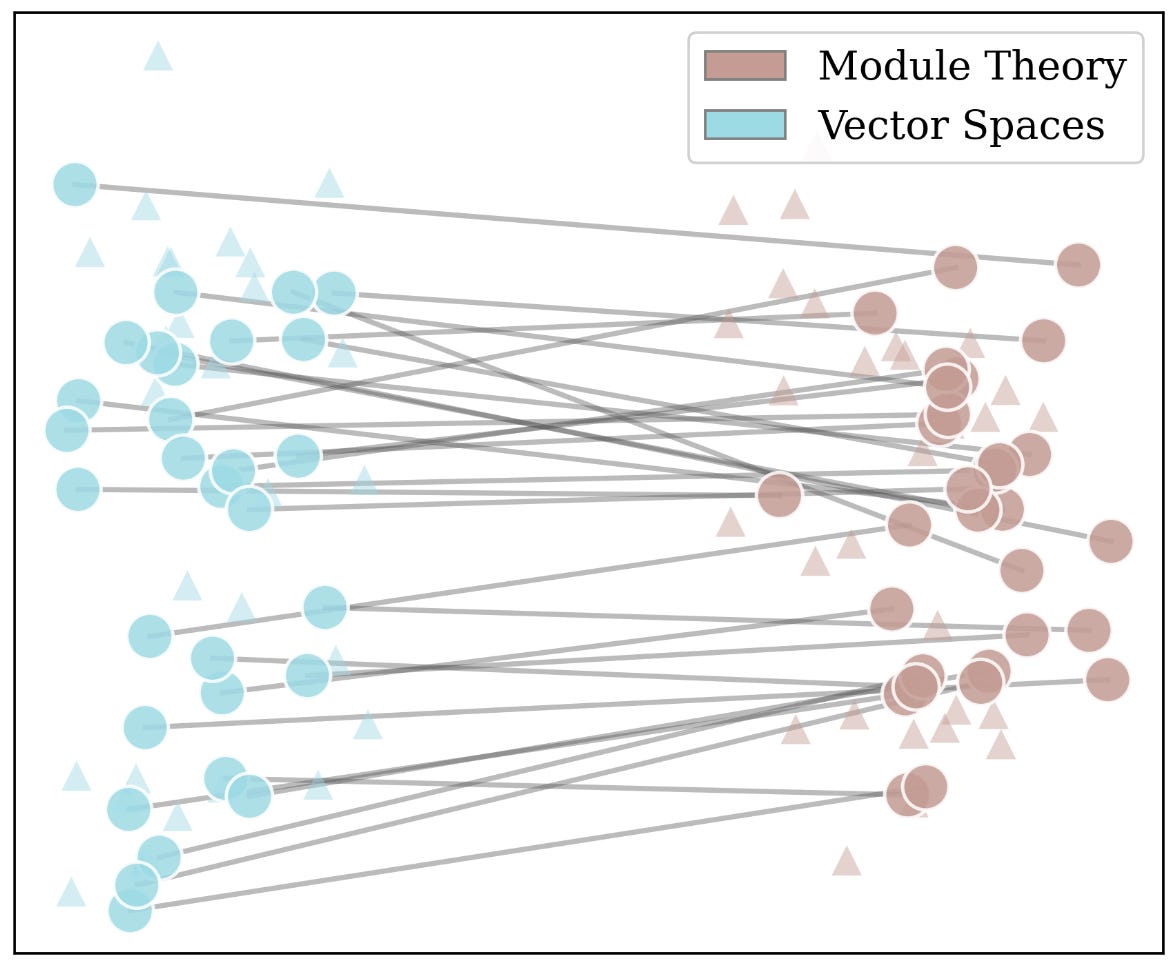
In the paper, we go on to outline a contrastive training approach for embedding models that treats different formalizations of a mathematical statement as different views on an underlying mathematical reality. Despite fine-tuning on a relatively small dataset drawn from mathlib, we saw a notable increase in performance on MELD. This is especially surprising since our training routine focused on collapsing distinctions between formal vs. informal not the language of one subfield vs. another. While we can’t say exactly why we see these improvements, we conjecture that forcing the model to reconcile formal vs. informal statements pushes it to focus more on mathematical meaning rather than surface-level lexical characteristics.
We are now starting the process of scaling up to include a larger set of mathematical statements with different types of ‘views’ beyond Lean vs. informal language. Several of my co-authors will be presenting this work at the 3rd AI for Math workshop at ICML on Saturday. If you are in Seoul, please check it out!
Specifically, the maintainers of https://www.erdosproblems.com/ had not included these solutions in their database.
Good read.
Tiny example here btw
https://schur.microprediction.org/map.html